
Story: "The Wolf's Christmas"
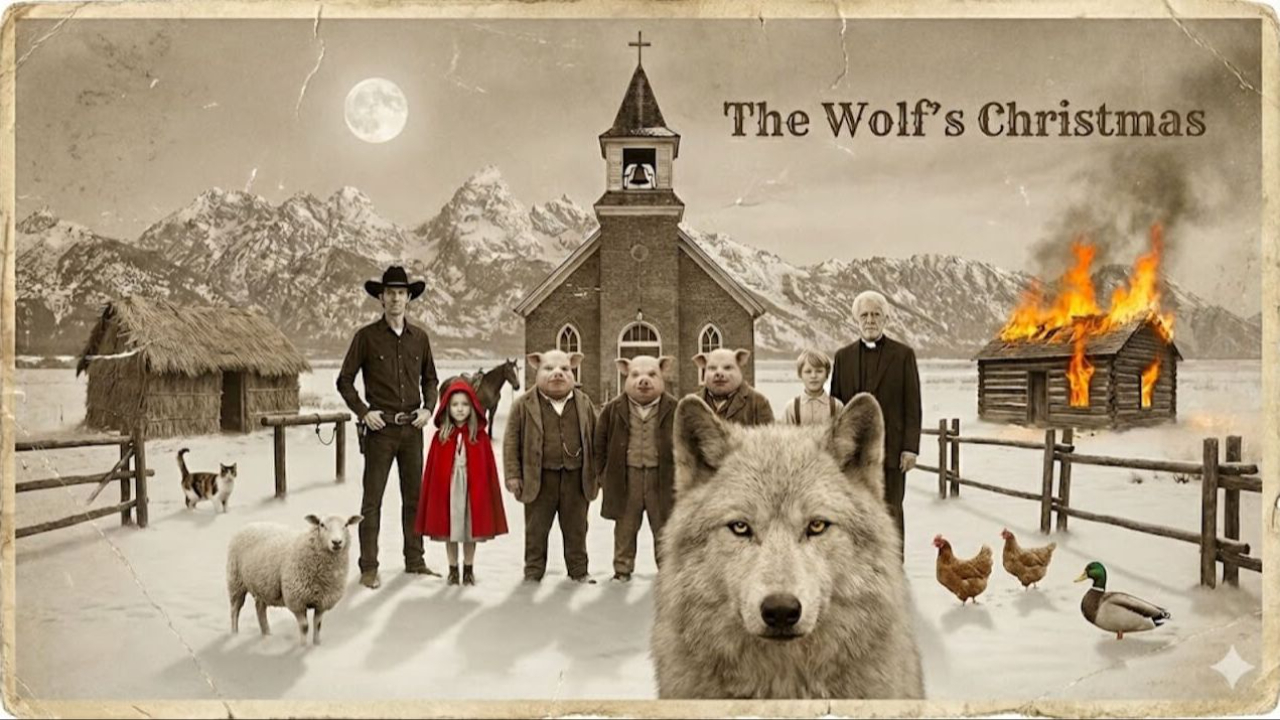
It was so terribly cold. Snow was falling, and it was almost dark. I lay in the cedar brake where my grandfather had denned before me and I did not move. Movement cost heat. Heat cost calories. And I was six days past my last calorie — a frozen rabbit I found under a deadfall, already dead, which I ate whole because that’s where we’re at now. Fur, bones, eyeballs, the works.
That’s the situation.
Below me the valley was coming alive with light. The Hogg cabins. The little brick church with the bell they hauled up from Missouri.
Christmas Eve. The birth of their god. I had learned their calendar the way you learn the habits of prey: by watching, by waiting, by remembering which moons brought the killing and which brought the feast.
And here’s the thing, here’s what gets me: I could hear them singing from the church when the wind dropped. Peace on earth, goodwill toward men. Not toward wolves. Never toward wolves.
They poisoned my mate two winters back. Put strychnine in a deer carcass and I watched her foam and seize in the snow and there was nothing I could do but stay with her until she was cold and then leave because that is how it is. You stay and then you go.
Thirty wolves in the Coldwater Pack when I was young. Then twelve. Then three. Now one old wolf on a hillside, watching the lights of his enemies burn in houses built on his father’s bones.
The snow kept falling.
The cold was in me now in a way it had not been before — not just around me but inside, settling into the spaces where the hunger had hollowed me out.
I was twelve winters old.
I was the last.
And I thought: so this is how it ends. Not with a hunt, not with a battle, just silence and snow and the sound of singing I was never meant to hear.
I stood up anyway. My legs were stiff but they held.
It was a bad idea, going down there. I knew that. But it was the only idea I had, and sometimes that’s enough.
Sometimes that’s all any of us get.
Hunger.
Down by the creek, Billy Hogg's cabin, the one he cobbled together from straw and sod and scrap lumber.
I could smell the food inside. Dried meat. A little grain. Not much. Still, saliva rose in anticipation, and the gnawing beast of starvation dug his sharp, cold teeth a bit deeper into my empty belly.
I circled the cabin. I could smell him too. Billy. The runt of the Hogg litter. Puny. Ornery. Mean.
If he'd been a wolf, a part of my old pack, when there still was a pack, I would have made him lower to the ground, tuck tail, pay respect, change his ways. And if he kept misbehaving, I would have driven him out of the pack for a period of isolation. Not permanent banishment, you see. A wayward wolf would learn their lesson, and would then be welcomed back to the pack, behavior corrected, all good, pack whole and stronger for it. But Billy was a human, and what's more, a reprobate. No changing him. His own two brothers barely tolerated him. And so he lived alone here in this straw house that didn't even keep the wind and the snow out.
I could see him through the little window. Billy was sitting alone at his ramshackle table, drinking firewater, the bottle half empty.
Then he spotted me outside. His eyes went wide. He went for the rifle.
I don't know what made me run at the cabin, instead of away. Hunger, I suppose. I could smell the meat and it drove me a bit mad.
I threw myself against the flimsy wall, and wouldn't you know it, the whole structure shuddered, then collapsed, straw and sod folding in on itself, crumbling down into a heap of the junk it was made from.
Billy scrambled out, ran away, shouting.
I pawed through the wreckage of the straw house. Found a heel of bread, a strip of dried venison. Two bites. It wasn't enough.
Hunger.
I followed Billy's trail. He'd run over to his brother Martin Hogg's cabin. Through the window I saw the brothers, lit by the kerosene lamp on the table between them, Billy wild-eyed, gesturing, Martin trying to calm him down.
Two humans. I should have run away. But then there was the smell. Not a little bit of dried meat. No. This was a whole steak cooking. It drove me out of my mind. There was no wolf sense left, no wolf wisdom, no wolf caution, only the hunger.
Martin's cabin was made of wood, stronger construction than his brother's flimsy straw house, but I could spot a gap up where the chimney met the roof — poor construction, rushed work.
The cabin was built as a lean-to against a large rock as its fourth wall. I scrambled up on the rock, then onto the roof, found that gap by the chimney, and now I got the scent of the steak wafting right up my nostrils. I started scrabbling with claws, gnawing with teeth, pulling, wrenching, and soon managed to dislodge one stick of wood, then another.
I could see the brothers down below. I could also see the steak.
Billy spotted me. Let out a howl of panic.
Martin grabbed his rifle, fired up at the ceiling. Missed me.
But the gunshot startled Martin's cat, who had been sleeping by the pot-bellied stove.
As the cat streaked across the room, over the table, the overturned kerosene lamp crashed down onto a bedroll on the floor.
The fire spread fast. Upwards, as fires do, burning through the roof, making the hole bigger.
I dropped through the hole into the cabin.
Martin and Billy scrambled out.
I grabbed that steak in my teeth and followed them out through the door, then watched them run downhill towards the safety of the little brick church.
I ate the steak in three hungry swallows as the stick house burned beside me.
The cat had made it outside. I could see his green eyes glowing in the dark, watching me. Always a troublemaker that one. Somehow I'd catch the blame, though. I could feel it in my bones. Wolves are always the bad guys in the story.
The hunger sated, somewhat, I made my way towards the brick church. I wanted to see who was there. Wanted to see, in particular, if Cornelius Hogg, the oldest of the Hogg brothers, was at church. Which meant he (and his rifle) wouldn't be at home.
Cornelius lived in a solid brick house. No way of getting at the delicious feasts he kept inside. But he did have an adjacent henhouse full of equally delicious, feathery food for a hungry wolf.
I moved through the timber, stopping at the edge of trees near the church. Through the tall windows, I saw the congregation gathered, candles burning everywhere.
I crept closer.
And yes, now I could see him, Cornelius Hogg, thick-necked, red-checked, upturned nose, little slits for eyes.
And there they were, Billy and Martin, standing in front of the congregation, telling their story.
"Eyes like hellfire, big as a horse, blew down my house with a giant puff of his foul wolf breath," Billy shouted.
"Sat my cabin ablaze with one stare from his terrible yellow wolf eyes," Martin embellished.
Peter, the young boy who tends the sheep down at the Ostergaard farm stood up.
"Maybe now you'll believe me," he said. "I've been telling you that wolf's been eating our sheep, and once he even ate a duck. I saw him."
Peter wasn't wrong. But what's a wolf to do? It's in my wolf nature to eat a sheep when I can, and a duck in a pinch.
"Thirty silver dollars." It was Cornelius Hogg, his face red, his jaw clenched. "That's the bounty I'll pay for old Gray John's pelt. I know it's him done this to my brothers, and he'll eat us out of sheep and hens."
"And ducks," Peter said.
"And ducks," Cornelius Hogg agreed. "And soon enough that wolf will get the taste for human flesh."
I saw Hunt Hood get up from his pew at the back of church, where he'd been sitting next to his wife and his young daughter, Ruby Hood, the one who carries food in a basket to her grandmother.
I knew what that bounty meant to Hunt Hood. Knew that hungry look.
If there was any man I was afraid of it was Hunt Hood, the tracker, the hunter. So, when he quietly left the church, I moved deeper into the shadows, pressing my body up against the bricks in the church wall.
So, I not only heard, but felt the voice of Reverend Elias Ostergaard, Peter's grandfather, as he thundered his sermon. His voice boomed through the bricks of the church and buzzed in my bones as he spoke.
"DOMINION," the Reverend bellowed. "The Lord our God has given us DOMINION over His creation, over the land, over the animals. And yes, that includes the wolf. It is God's command that we tame this wilderness, advance God's Kingdom, and bring the light of civilization to this heathen land."
And I saw in the faces of the congregation — in that light in their eyes, the light of civilization — that my way of life was doomed. They could not be stopped. Not only would they kill me, they would kill my story, change it into their myth, their legend, their fairy tale. I would become, in their telling, the Big Bad Wolf.
— THE END —
The story was inspired by this Reedsy.com writing prompt:
Write a story from the perspective/POV of a non-human or fairy tale character sharing their side of the story.
https://blog.reedsy.com/creative-writing-prompts
Stay connected with news and updates!
Join the StoryBuzz mailing list to receive the latest news and updates.
Don't worry, your information will not be shared. Review our Privacy Policy.
We hate SPAM. We will never sell your information, for any reason. Unsubscribe at any time.
